
Commercial Construction Management Guide
A practical framework for managing commercial construction scope, responsibilities, schedule, risk, cost, submittals, changes, quality, and closeout.

Commercial construction management is the coordinated control of scope, responsibilities, schedule, cost, risk, information, quality, and closeout. It does not replace the architect, engineer, contractor, owner, or authority having jurisdiction. Its value is making decisions, obligations, and unresolved risks visible early enough to manage them.
Key takeaways
- Define authority and responsibility before establishing reporting routines.
- Maintain one approved baseline for scope, budget, and schedule.
- Connect every risk to an owner, response, deadline, and possible cost or time effect.
- Track decisions and submittals by the date they are needed in the field.
- Evaluate changes for scope, schedule, operations, and closeout impact before approval.
- Begin turnover planning during design rather than at substantial completion.
Establish the management structure
The project execution plan should identify the owner, decision-makers, design team, construction team, property operations, users, landlord representatives, consultants, utilities, and approval agencies. It should also distinguish who recommends, who reviews, who approves, and who performs each task.
Define:
- contract relationships and communication paths;
- financial approval limits;
- authority to direct work;
- responsibility for code and permit coordination;
- meeting types, attendees, and decision deadlines;
- document platform and naming rules;
- escalation path for safety, quality, schedule, and commercial disputes.
Unclear authority creates parallel instructions. A meeting note cannot correct a contract structure that allows several people to give conflicting direction.
Create one project baseline
The baseline is the approved reference for measuring change. It should combine the project objectives, scope, milestone schedule, budget, procurement strategy, operational constraints, risk assumptions, and quality expectations.
The U.S. General Services Administration describes a project management plan as a document that guides execution and control by assembling objectives, risks, strategies, and planning outputs. Private projects use different forms, but the principle remains useful: the baseline must be understandable, current, and tied to approved decisions.
Record assumptions separately from confirmed facts. Examples include anticipated permit duration, access hours, utility capacity, landlord review time, lead time for equipment, availability of existing drawings, or the ability to shut down an occupied area.
Build a schedule that explains the work
A useful schedule is more than a completion date. It shows design releases, owner decisions, agency reviews, procurement, enabling work, construction sequence, inspections, testing, turnover, and time contingency.
For each activity, confirm:
- What must be complete before it starts?
- Who provides the input or approval?
- What material, labor, access, or shutdown is required?
- What event proves the activity is complete?
- What downstream work changes if it is late?
GSA’s current schedule guidance emphasizes collaboration, sufficient detail, clear milestones, and the connection between scope, cost, and time. That guidance is written for federal work, but it illustrates a sound management principle for other commercial projects.
Update actual progress without rewriting history. If the planned sequence changes, retain the approved baseline and document the reason, impact, and recovery decision.
Maintain a decision and information system
Construction teams exchange requests for information, submittals, samples, mockups, meeting actions, inspection reports, field observations, photographs, test results, and change documents. The register should connect each item to the schedule rather than simply recording the date it arrived.
Track:
- responsible party;
- date submitted;
- date required for procurement or field work;
- review status;
- linked drawing, specification, or contract requirement;
- effect of late response;
- final disposition and where the approved record is stored.
Submittal approval does not transfer design or installation responsibility unless the contract explicitly says so. The management process should follow the actual agreement.
Use a live risk register
A risk is an uncertain condition that may affect objectives. An issue is already happening. Keep them distinct so the team can still act before a risk becomes an issue.
For each risk, record:
- cause and possible event;
- affected scope, cost, schedule, safety, quality, or operations;
- probability and impact using an agreed scale;
- early warning indicators;
- mitigation and contingency response;
- owner and response date;
- remaining risk after the response.
Common commercial risks include incomplete existing-condition information, hazardous materials, long-lead equipment, utility shutdowns, landlord approvals, occupied adjacencies, insufficient design coordination, unavailable matching materials, and late user decisions.
Control cost through scope clarity
Cost reports should reconcile the approved budget, commitments, invoices, pending changes, forecast changes, allowances, contingency, and estimated cost at completion. Avoid presenting unapproved savings as available budget.
When a change is proposed, evaluate:
- why it is required;
- whether it is inside or outside the original scope;
- available alternatives;
- direct and indirect cost;
- schedule and procurement effect;
- operational or maintenance effect;
- design and permit revisions;
- effect on warranties, commissioning, and closeout.
The contractor bid comparison guide provides a method for normalizing scope before contract award. During construction, the same discipline helps distinguish a real change from work that was already required.
Plan occupied-building work separately
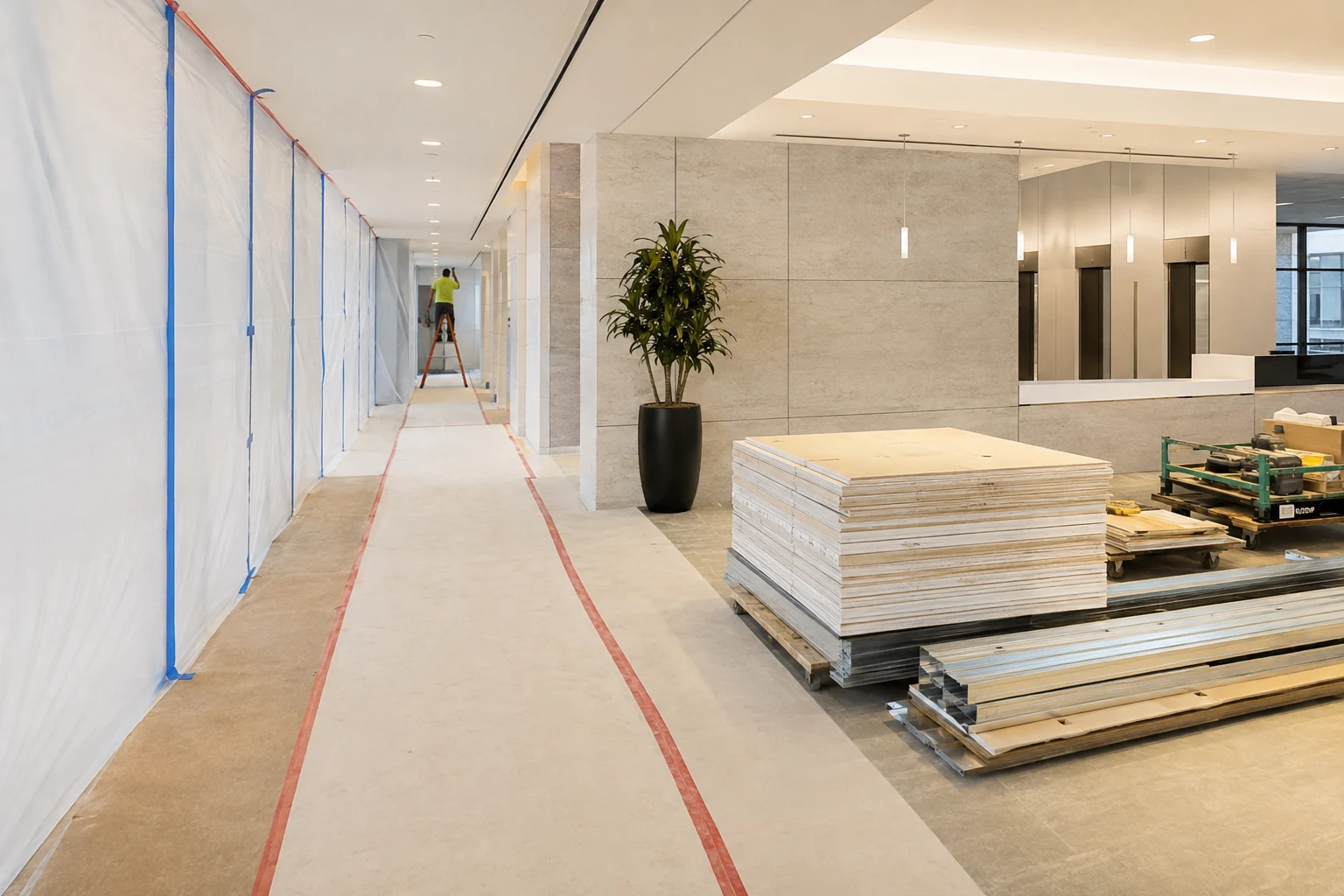
An occupied renovation needs an operational plan in addition to a construction schedule. Identify working hours, noise and vibration limits, dust and odor control, temporary exits, fire-system impairments, utility shutdowns, delivery routes, security boundaries, and communication with occupants.
Do not remove or block an exit based only on a field conversation. Changes affecting egress, fire protection, accessibility, or occupied conditions require appropriate review, approvals, and temporary measures.
The commercial renovation guide covers due diligence, phasing, and approval paths in more detail.
Verify quality before concealment
Quality control is the contractor’s process for delivering the required work. Quality assurance is the owner’s or design team’s verification strategy. The project plan should define both without blurring contract responsibilities.
Use preparatory meetings, approved submittals, mockups, first-installation reviews, testing, observations, and hold points for work that becomes difficult to inspect later. Exterior transitions deserve special attention because several trades may share responsibility for one drainage or air-barrier connection. The building envelope guide explains those control-layer relationships.
Start closeout during design
Closeout requirements affect procurement, installation, testing, training, and documentation. Create the closeout register before construction and assign responsibility for:
- permits and final inspections;
- testing and commissioning;
- punch-list completion;
- record drawings and approved changes;
- operation and maintenance information;
- warranties and attic stock;
- owner and facilities training;
- keys, access controls, and asset data;
- certificates and occupancy approvals;
- unresolved seasonal or deferred tests.
Substantial completion, occupancy, contract completion, and financial closeout may be different milestones. Define them rather than using the terms interchangeably.
Sources and limitations
- GSA project management plan guidance
- GSA schedule management guidance
- OSHA fire-service features and occupied-building access examples
GSA and OSHA resources provide useful official examples but do not define every private project’s contractual duties. The governing agreements, adopted codes, approved documents, and authority having jurisdiction control the actual project.
Related articles
Commercial Renovation Planning Guide
How to organize due diligence, approvals, scope, phasing, procurement, and turnover for a commercial renovation or tenant improvement.
Read article
How to Compare Contractor Bids
A structured method for comparing scope, allowances, exclusions, schedule, qualifications, and risk instead of choosing by total price alone.
Read article
Building Envelope Basics for West Coast Projects
A clear guide to water, air, vapor, and thermal control layers, plus the transitions that determine wall and roof durability.
Read article